The Wildlife of Ancient Crete: Cretan Owl (Athene cretensis) 🦉

Long ago, during a time period far before Minoan civilization (the Pleistocene or Ice Age), the Cretan Owl dwelled and thrived before its untimely extinction. The last of this species tapered off after the island was inhabited by humans. While 130,000-year-old stone tools were found on Crete, denoting the brief settlement of early hominids, humans officially settled there around 6,500 BCE. Late Miocene (approximately 11 million years ago) fossil remains from Northeastern Hungary have been assigned to this genus of owls (Athene).

Athene cretensis’ first appearance was in a scholarly paper by paleontologist P.D.M. Weesie titled “A Pleistocene endemic island form within the genus Athene: Athene cretensis” (published in 1982).

a reconstruction of the Cretan owl

At roughly 23 inches (60 centimeters), the Cretan owl towered over the present-day little owl (Athene noctua). Flightless or near-flightless, its short wings and long legs ensured a terrestrial advantage over its feathered counterparts. Its legs gradually lengthened over time. Athene cretensis also had a notably different humerus from other owls. The bone structure reflects the fact that this owl didn’t have any known predators, so flight wasn’t entirely necessary for its survival.

Due to the Cretan owl pellets that were recovered from the Liko cave, this owl’s primary prey was rodents, but especially the endemic mouse Mus minotaurus, which was one of the largest in its genus.

One of the likely reasons that A. cretensis went extinct is that its main food source also went extinct. The arrival of humans also introduced a new predator into the area that this bird didn’t need to worry about before. At that point, its ground-dwelling tendencies were a major disadvantage.

“A Pleistocene endemic island form within the genus Athene: Athene cretensis” by P.D.M. Weesie
A Mystifying Minoan Monument Recently Discovered in Crete

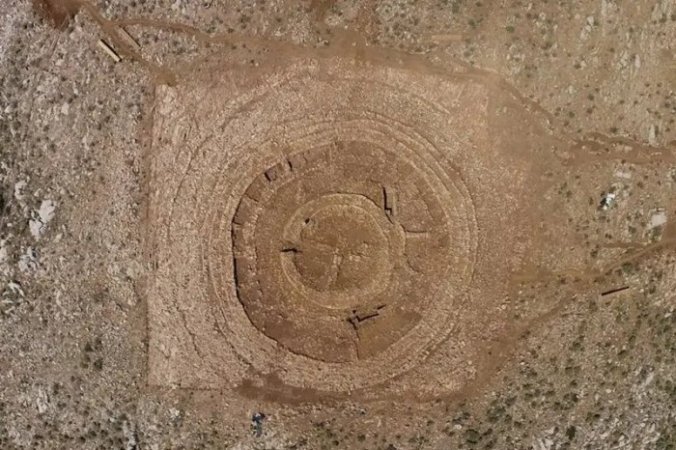
In June 2024, on Papoura Hill in Kastelli, Heraklion, Crete, an ancient monument was discovered that has both mystified archaeologists and offset the plans for a new airport. As with so many discoveries related to Minoan civilization, the purpose of this expansize maze-like structure is unknown.

However, here is what’s presently known:
🔸 It stems from the Protopalatial period (2000-1700 BCE – based on the style of pottery fragments found nearby).
🔸 It was built utilizing eight 1.4-meter-thick stone rings.
🔸 It spans 157 feet in diameter.

Surprisingly, parts of it are still well-preserved.

An aerial view of the circular structure. Credit: The Greek Ministry of Culture

According to The Greek Ministry of Culture, some of its features are notably similar to Minoan tombs and Hellenic mounds due to the intricate, circular stone-ring arrangement. What’s undermining this specific  speculation is the vast number of ancient animal bones that have been uncovered. That finding, along with its location (an area of elevation), potentially points to a monument with a ritualistic purpose (offerings, sacrifices, feasts, etc.).

While these speculations seem sound, the construction plan itself did not share many similarities to other Cretan buildings of the same time period. Instead, it more closely resembled constructions from West Asia in the brink of the Bronze Age (i.e. the elliptical Middle Minoan building of Hamaizius and a circular proto-Hellenic cyclopean building of Tiryns).

In addition to this labyrinthine structure, excavations have unearthed over 30 other archaeological sites throughout the area. A new airport has already been in-progress, but now that such amazing archaeological findings have been unveiled, a balance between modernization and maintaining cultural heritage must be maintained. In fact, when discussed, it was concluded that the latter is to be continually prioritized.

In general, The Greek Ministry of Culture is devoted to protecting ancient sites from modern development to safeguard the continuation of research and the conservation of history. This recent discovery, among dozens of others, gives deeper insight into a rich culture that still mystifies researchers to this day.

The Goings-On of the Ancient Cretans by Eleanor Kuhns

Loving these insights into the Minoan culture, Eleanor!

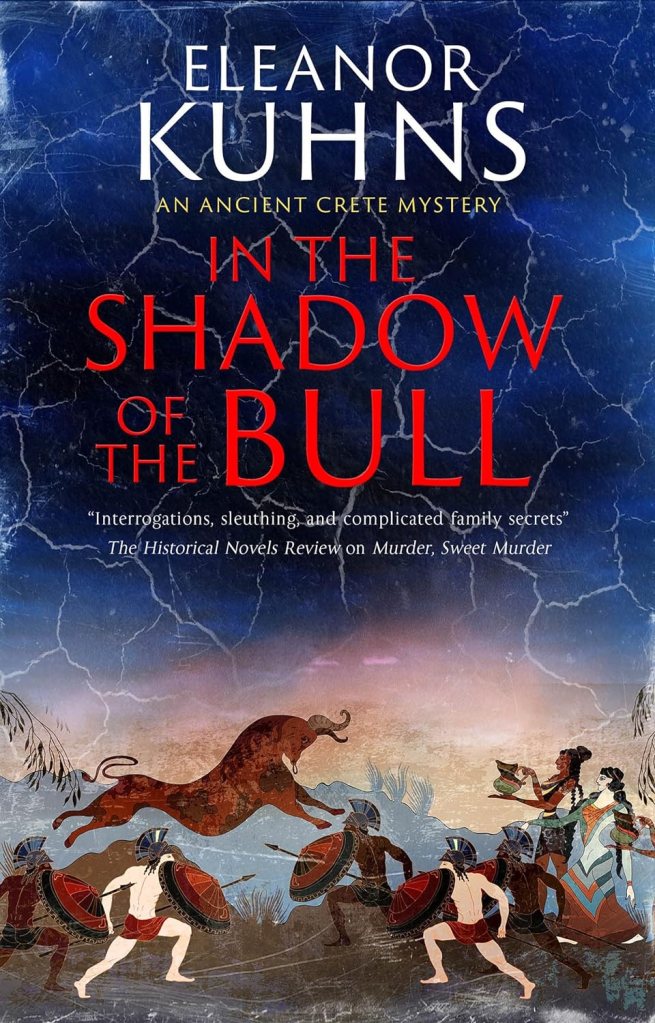
Speaking of which, I’ve been reading Eleanor’s Ancient Cretan mystery novel In the Shadow of the Bull, and the details are incredible. What an immersive experience it has been! As I get towards the end, I’m already excited about (and honestly can’t wait for) book 2. I’ll definitely post a book review in the future. 😀

Get your own copy here.