Minoan Spring (a poem)

a researched poem about the vernal equinox in Ancient Crete

Warm westerly winds replace the biting gales of the north.
Crocus, poppy, and lily saplings slowly spring forth.
Rainy season makes its anticipated exodus as March wanes,
the sunshine igniting a mountainous scene amidst flowery plains.

The Mother Goddess’ blessings are ever-bountiful,
and so, her devotees honor her with a vibrant spring festival
brimming with offerings, worship, sacrifices, and ecstatic dance
to ensure another year of fertility, flourishment, and favorable circumstance.

In the sustained daylight and deep into the night,
they jubilantly celebrate the cyclical rhythms of life
and their spiritual ties to the natural world—
whether olive, boar or bee, existence ebbs and unfurls.
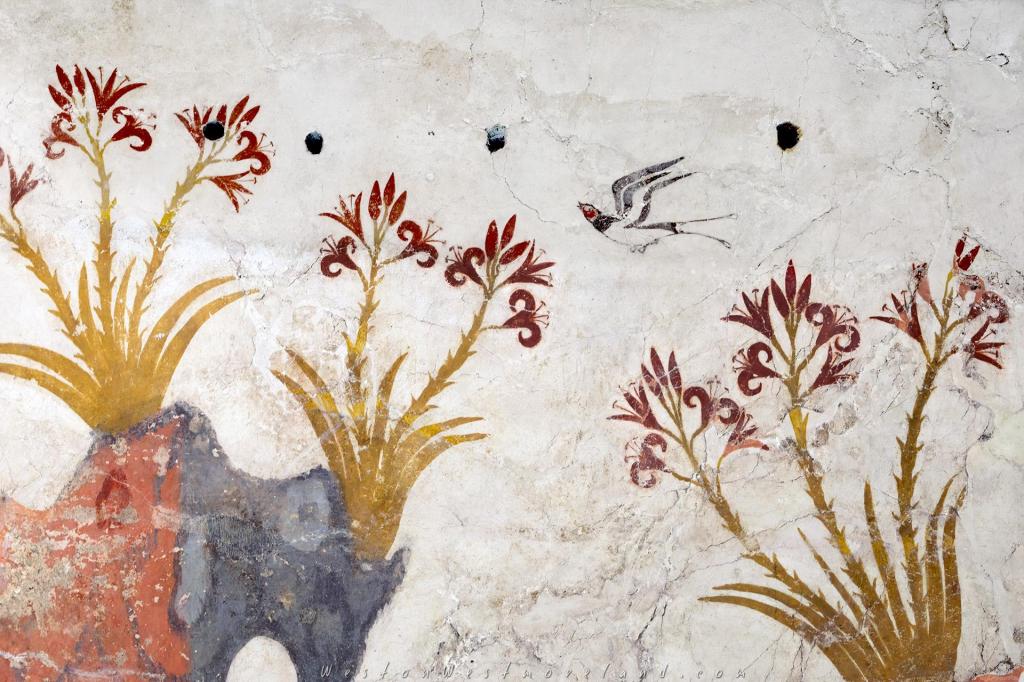
a close-up of the Spring Fresco from Akrokriti, depicting a rocky landscape with lilies and swallows

A Neophyte Bull-Leaper’s First Leap (a poem)

a mythological poetic story about a nervous yet brave novice bull-leaper (inspired by “The Bull-Leaping Fresco” and Martis, the main character of Eleanor Kuhn’s book “On the Horns of Death”)

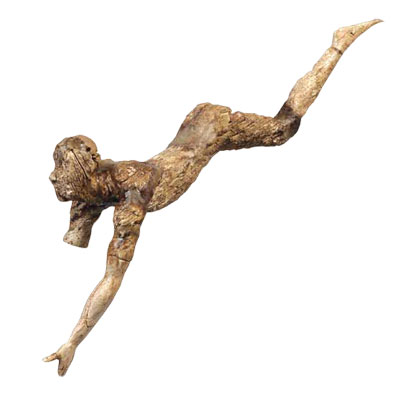
an ivory figurine of a bull-leaper recovered from Knossos, 1600–1500 BCE

Body frozen in place by neophyte’s first-leap nerves.
Neither a blink nor a breath as she nears her turn.

First, it is her soul who leaps out of her chest and enters the ring
as a bull white as ivory charges towards her in full swing,
galloping hooves syncing with her quickening heartbeat.

And so, she grabs the creature by the horns and flips,
ironclad her determination and grip,
then smooth as still sea, vaults over its back,
landing feet first assuredly upon the sand.

But as her turn arrives in real-time, she averts her eyes
and side-steps, barely veering from her demise.
Her fellow leapers try to pull her from the bull’s line of sight,
yet she remains a pillar unmoving; she must give it another try.

So, as the bull comes back around,
heaving as it tires from countless rounds,
she takes a deep breath and braces herself,
and as if divinely guided by The Goddess,
grasps the beast by the horns with calloused hands,
vaults, and lands, freezing in place upon his coarse back.
Her arms quiver in both excitement and fear
while her comrades gasp and cheer.

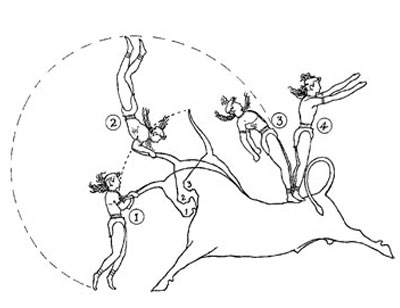
a line drawing by Sir Arthur Evans depicting the steps of bull-leaping

A Union Blessed by The Minoan Snake Goddess (a poem)

a mythological poetic story inspired by the Minoan religion and their sacred rites

Black snakes coil down The Priestess’ arms,
and like fine silk in steady wind, slither upon
a stone pillar etched in Linear A,
where they entwine like DNA
alongside offerings of bull’s blood, honey, and olive oil.
All falls silent, between sky and soil.


It is then that The Priestess and her procession make a plea
to The Snake Goddess:

Hail, A-ta-no-dju-wa-ja,
Goddess of Fertility!
Bless this union as sacred as sea:
one a celebrated bull-leaper,
the other an adept healer.

May she, the contender of bulls, continue to leap unscathed.
May he, the alchemist of medicine, continue to restore the sick’s fate.
As souls united,
may their love remain requited.
May their children lead bountiful lives,
and may the lineage continue to thrive.

Both bride and groom reach their arms out towards the dual snakes,
and, as if by the Goddess’ decree, they reanimate
and start to coil up their adjacent arms and conjoin at the tails.
The blessing of Atana Potinija is now upon them!
The union shall, through devastation and elation, prevail!

a fresco of a Minoan bride and a groom. It is customary for women to be depicted as pale 
and men to be depicted as tan in Minoan frescoes.
a Minoan-fresco-inspired illustration of a Minoan bride and groom by Luisa Donber. It is customary for women to be depicted as pale and men to be depicted as tan in Minoan frescoes.