a piece about my unforgettable visit to the Palace of Knossos that connected me to my ancestors in a way nothing else has…
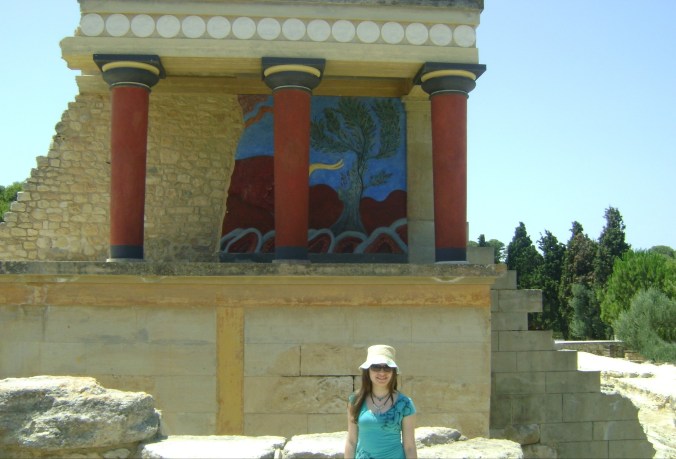
me by the Restored North Entrance with the Charging Bull Fresco
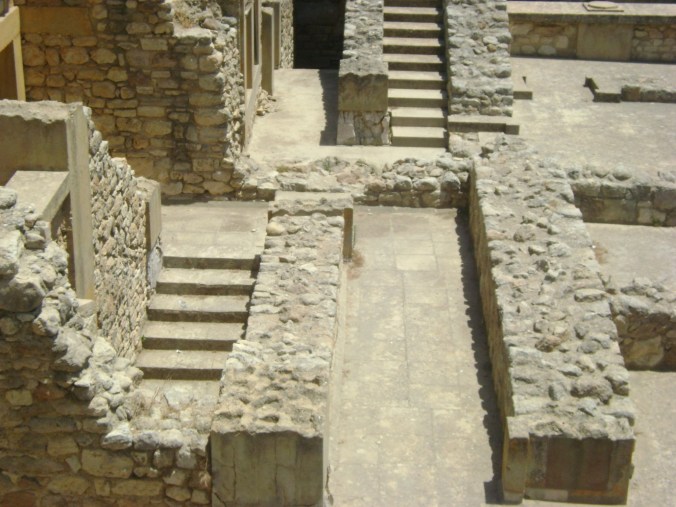
Mid-July sun scalds skin and ancient sites indiscriminately and illuminates the same steps my ancestors took thousands of years ago. The trickles of sweat down my brow are overshadowed by the tingle up and down my spine as I approach pithoi1 that once contained oil from olive trees that may still live to this day,2 vibrant frescoes that still echo the artistry of masterful Minoans despite destruction by both nature’s and occupiers’ hands and some questionable reconstructions, labyrinthine paths that, along with midday heat, further dizzy me.
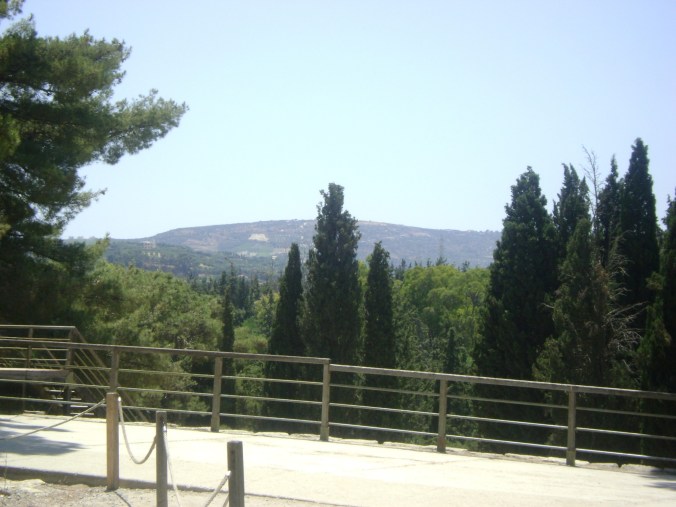
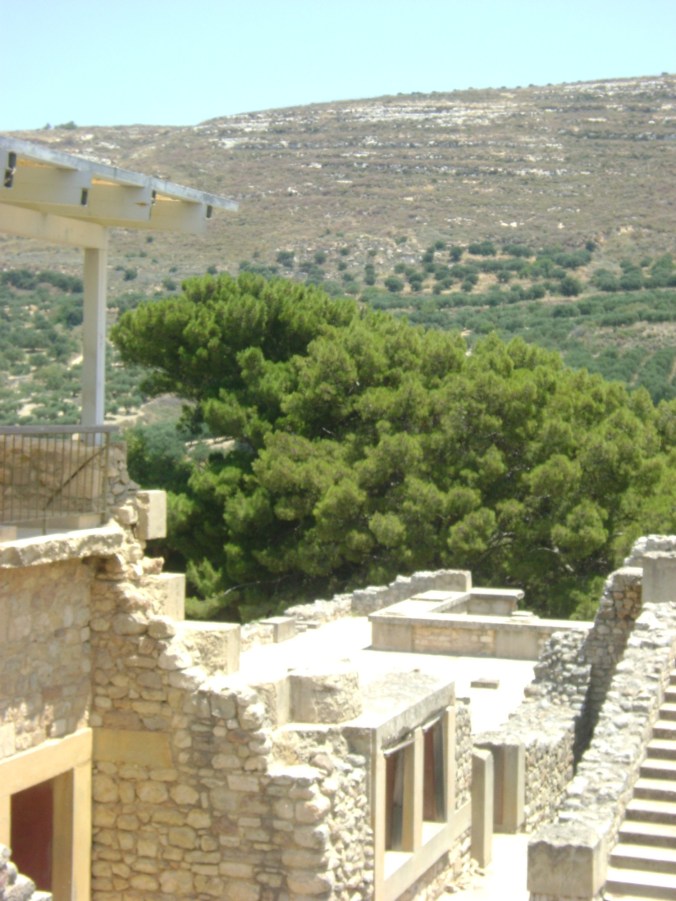
Mouth dry but mind bedazzled by Mount Juktas (Γιούχτας)3 nearby and Kephala Hill (Κεφάλα) upon which Knossos (Κνωσσός) was built that have seen it all since the dawn of their time, stone pines and cypress that envelop the sacred ruins and perfume the air with an earthy resinous aroma that graced festivals and rituals millennia ago.
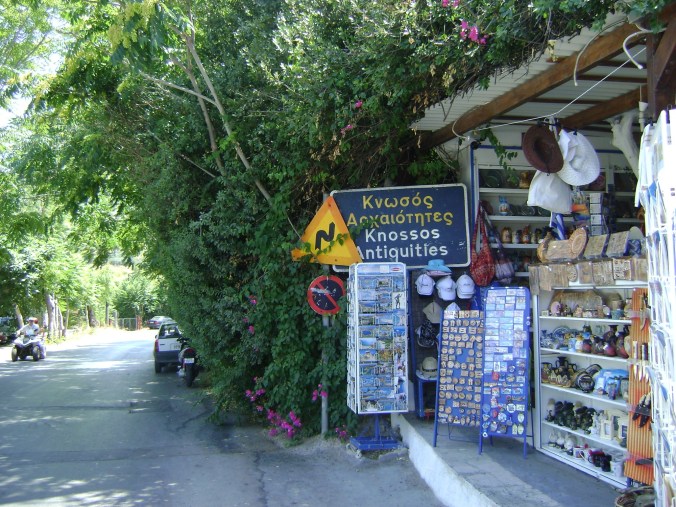
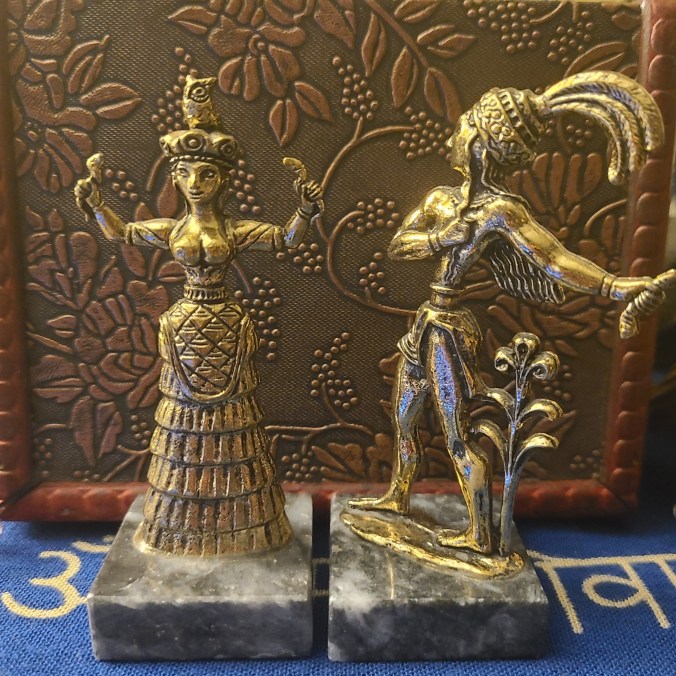
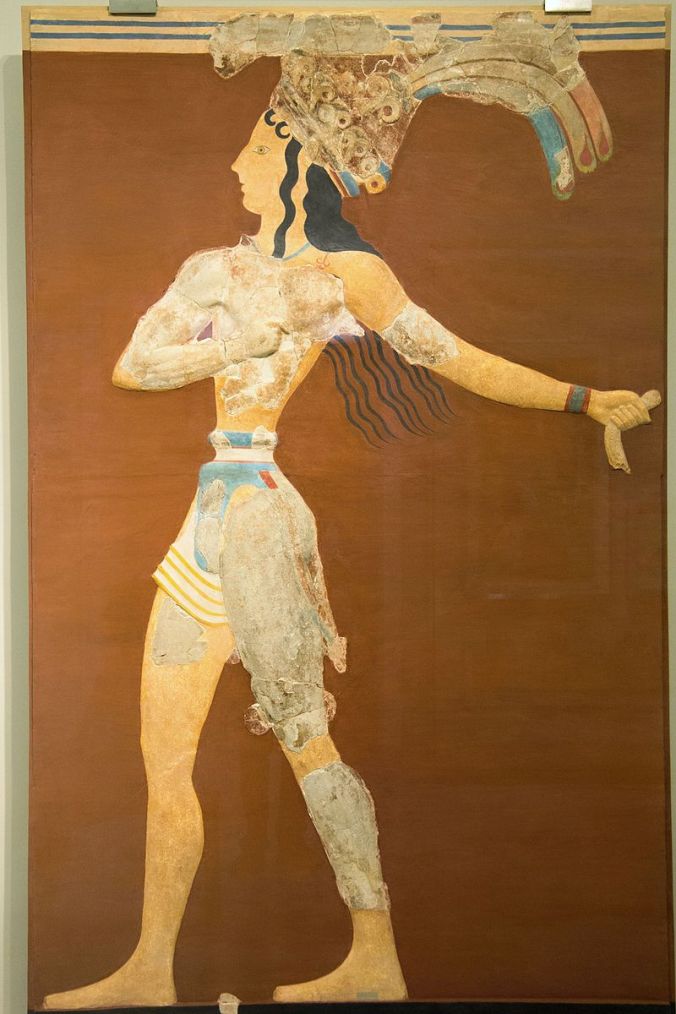
Finding solace in the shade of a souvenir shop with the words “Knossos Antiquities” on the side and shrubbery along the top, I immediately decide on a golden figurine of the Snake Goddess with an owl atop her head, not a cat that Arthur Evans and Halvor Bagge proposed and transposed upon her crown. As the sun shines just right, I then catch a glimpse of a mini Lily Prince with a similar golden finish and know then and there: I just have to have it! Having promised my friends overseas that I’d send them post cards, I also select several that show Knossos in its most magnificent light.
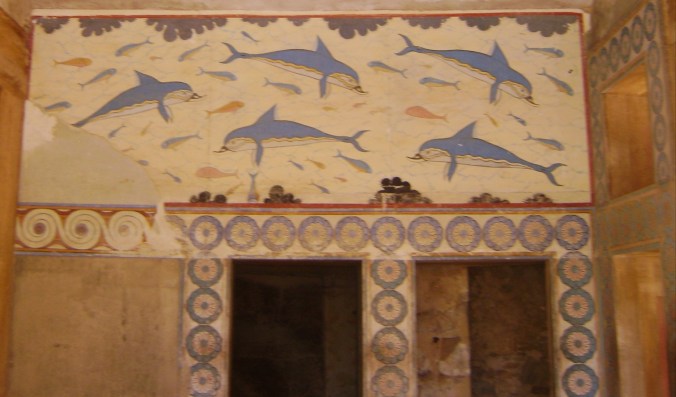
Upon returning to grandma’s (γιαγιά) house, and after being well-fed, of course, a satisfying exhaustion takes over my body and I fall into a deep sleep, charging bulls, dolphins, and griffins infiltrating my dreams. The Lily Priest-King and The Snake Goddess themselves observe me from afar with knowing smiles but grave eyes as it starts raining rosettes. A sudden tidal wave hits the Palace, and a chilling darkness overcomes me. I wake in a cold sweat in the same blackness and fear I haven’t awakened at all4…
I may have left, but the magic of Knossos will never leave my heart and psyche, even if I never set foot there ever again6.
*More photos from my trip can be viewed here. Please pardon the blurriness in some – these were all taken with a relatively cheap digital camera back in 2011…
a Minoan-inspired poetic story about how The Lily Prince got his name
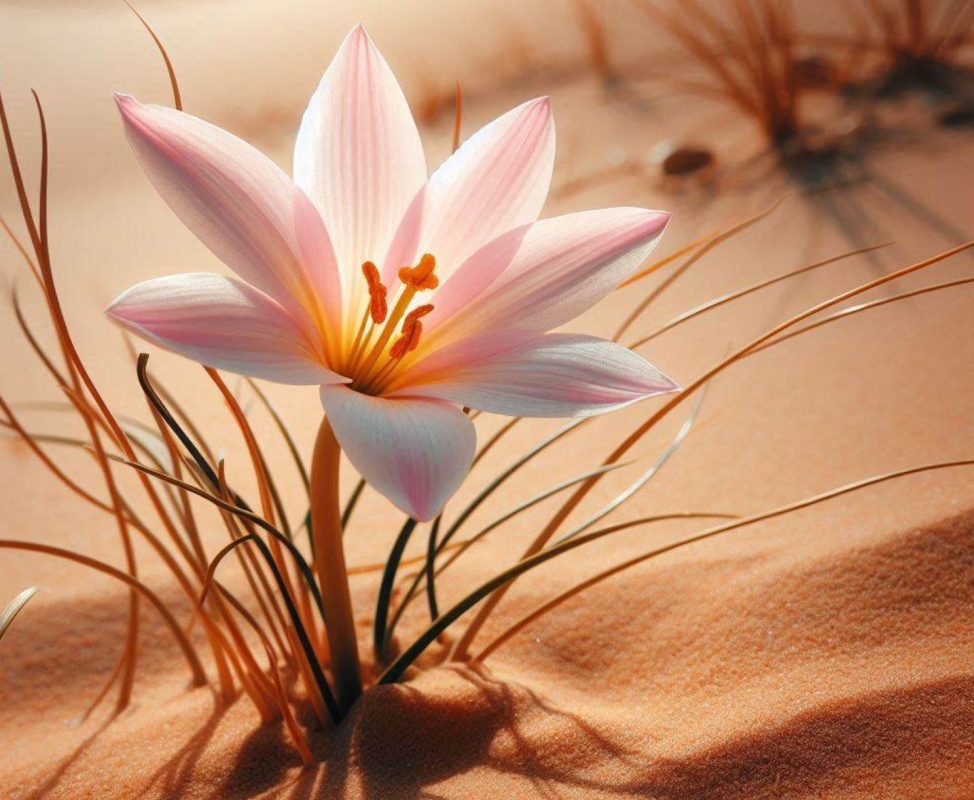
Soon after he took his initial steps, his heart was drawn to the coast at sunset bedecked with rosen cumulus clouds. The seagulls’1 elegiac yeows set to the Aegean’s sonorous symphony— all served as an invitation from the sand lilies2.
So, the young wide-eyed prince wandered off every opportune moment he got to inhale the warm salted air sweetened by the flowers’ subtle flair.
But it wasn’t long before his mother caught up and urged him to return with her to the palace at once. And he would oblige, for he was the Wanax’s3 son, but not before he picked her the most vibrant one.
Cretan sand lily from Wikimedia Commons
P.S. You’ll be seeing quite a bit of Minoan-inspired poems from me this month because it’s National Poetry Month/NaPoWriMo. 😀
Seabirds of the genus Larus were likely present in ancient Crete. ↩︎
Also known as a sea daffodil or sea lily (Pancratium maritimum), the sand lily is native to Crete and has been around since prehistoric times, with the Minoans depicting it in their art. ↩︎
“king” in Mycenaean Greek (pronounced as wa-na-ka in Linear B). While not directly associated with Minoan rulers, there is evidence of kings in Minoan Crete, but there is no known word for them. ↩︎
As World Poetry Day comes to an end, I wanted to compile poetry inspired by The Minoans. Upon scouring the internet, I unfortunately couldn’t find that much, but I’ve included everything I came across along with info on the poets if I could find any. I’ll add to this over time, so make sure to check back every so often. If you’d like to read prior Minoan-inspired poems I’ve written, go here.
With no further ado, grab a heaping cup of your favorite tea and prepare to be teleported to the ever-magical Minoan Crete!
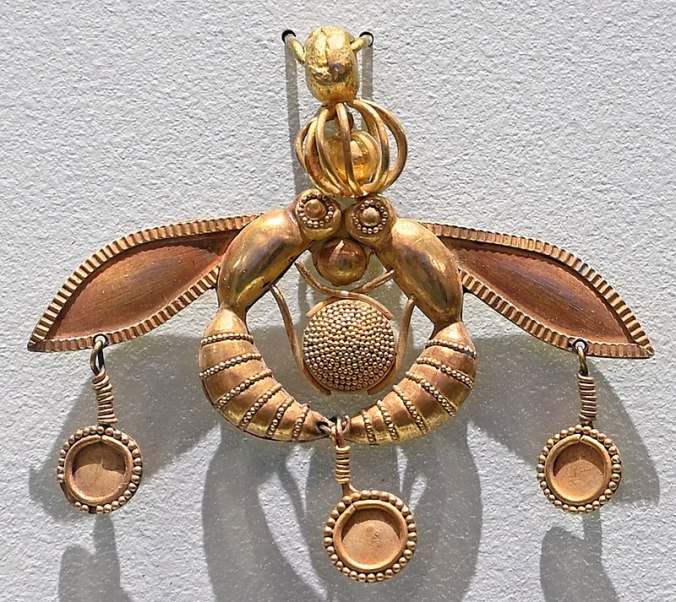
Minoan Pendant by Mark Granier
Yes – I press my nose to the pleasantly warm glass – it’s a copy of one I saw cased in the cool museum – gold beaten to honey, a grainy oval dollop, flanked by two slim symmetrical bees –
garland for a civilisation’s rise and collapse, eye-dropped five thousand years: a flash of evening sun on a windscreen or wing mirror – Heraklion’s scooter-life buzzing and humming –
as I step in to browse, become mesmerised by the warm dark eyes of the woman who gives her spiel and moves softly and with such grace, that, after leaving, I hesitate
a moment on the pavement then re-enter with a question I know not to ask, but ask anyway, to hear her voice soften even more as she smiles and shakes her hair – no.
Mark Granier born in London, England, is an Irish poet and photographer based in Dublin, Ireland.
Minoan Porcelain by Aldous Huxley
Her eyes of bright unwinking glaze All imperturbable do not Even make pretences to regard The justing absence of her stays, Where many a Tyrian gallipot Excites desire with spilth of nard. The bistred rims above the fard Of cheeks as red as bergamot Attest that no shamefaced delays Will clog fulfilment, nor [impede] Full payment of the Cyprian’s praise Down to the last remorseful jot. Hail priestess of we know not what Strange cult of Mycenean days!
Aldous Huxley was an English writer and philosopher who produced a bibliography of nearly fifty books.
Minoan Dreams by DreamWidth User GingiCat
The Minoan girl dreams of the Moon surrounded by shining stars and wishes she could go there.
She dreams of a boy dancing with bolts of red and blue magic in his hands like straight snakes.
She dreams of him among the stars, the dust of the moon on his bare feet.
The Minoan girl draws pictures of the stars in their places and diagrams their influence on the little house magics that she knows how to cast.
They’re just dreams, as she goes about her day—
but they won’t always be.
The Goddess and The Bull by LiveJournal User BrownGirl
When the Goddess came down to Crete, Which was Minoa of old, She came in the form of a woman, Her skirt belling like the sails of a ship.
When the God came down to Crete, To Minoa before the Diaspora, He came in the form of a bull, His black sides broader than a ship’s hull.
They danced together, And when she kissed his poll Her lips left a mark like a star, White against his flawless dark.
In Minoa before the waves rose And the temples fell, the priestesses Would dance with the god-blessed bulls who, As calves, had slobbered kisses on novice hands.
The children born to the holy women Were held sacred, believed to hold both Women’s wisdom and bull’s strength, Able to find their way through the world’s maze.
It is this which the myth of the Minotaur mocks, The Labyrinth laughing down time at the bull-leapers, But the skin of Crete lies over the bones of Minoa And it is the bones that give shape to the body.
Minoan Snake Goddess by Patti Masterman
Long black robe of the house dress And the animal that decorates her Waits at the end of a strap Instead of atop her stone head At night the snakes seem lively Serpentine extensions of her short arms She belches brimstone and mutters endless Half-baked deprecations As she staggers to the john The alcoholic elixir tangling her brains axions Bellow and curse fall randomly On furniture, carpet, and sleeping creatures Her dangling breasts sway to no metered ritual She is the artifact now of a dead civilization Still trying to convince herself she was once the epitome Of feminine courage and power Her worshipers now just sleeping dust Her idols cracked faience, with white rimmed eyes She lurches along her slowed down calendar Slogs drunkenly through the wavering pestilence That has become her life Maybe she senses that at the end When she has sucked out every ounce of energy and truth From everything she’s ever touched The snakes will turn inward and devour her completely And only her footprints remaining on weary earth.
Bull-Fighting by Raj Nandy
(I) The Minoan Civilization of ancient Greece, Was well centered in the Aegean island of Crete; And around 1600 BC this civilization had peaked! Seeing their frescoes, and paintings on potteries and vase, Scholars concluded that ‘bull-jumping’ was perfected as a gallant art! Those jumpers grabbed the bull’s horns, – And receiving momentum from its violent head-****, Vaulted over its back in a somersault, To land on both feet to break their fall! I was spell bound by Minoans courage and agility, Their acrobatic feats performed with such dexterity! Those bulls were not killed and no blood was shed, Some acrobats might have been injured instead! What a shame for our bull fighters of date!
(II) Today bull fighting has become a popular sport, Where the bull gets slaughtered amidst loud applaud! I recall those Roman amphitheaters that remained jam-packed, When the Gladiators performed their fatal acts! But even those Gladiators had a chance to survive, Our cornered bull has no place to hide! Friends, to see blood is an age old thrill, But none would like to see their own blood spilled!
(III) Our Matador today is like a popular Rock Star, While the bull becomes a martyr in the pit by far! The bull’s mighty horns are sharp and strong, Can lift up a man like a rag doll! But when the Picador lances the bull’s ****, The bull never gets a fair deal and jumps! Next the Matador waves his ‘muleta’- a red cape, The bull makes a final charge but cannot escape! I wonder if the bull sees red!? The Matador then amidst much pomp and applaud, Spikes the neck severing the bull’s spinal cord! He is greeted by flowers and cheers of ‘Ole’! ‘Ole’! Let us learn from those Ancient Minoans, – That’s all I have got to say!
Raj Nandy was born before India’s Independence. He graduated with Honors in English Literature from Presidency College Calcutta, and also obtained a first class in MBA.
Iris-W by Dr. Ram Mehta
Prized for perfumes and medicines, Rainbow personified & God’s messenger, Resting the souls of dead women, Decorum of the graves, Delight of the ancient artists.
Blooming on Minoan Walls, Sculptured in stone at Karnak. Living memories of the French revolution. Clovis put you on his banner And won over Germanic tribe. Louis VII adopted you as device, ‘Fleur-de-lis’ the symbol of France. Germany suspended you in beer barrels, And France to enrich the wine, England to give flavour to brandies, And Russia flavoured a soft drink.
Then, plucked in a state of chastity, Now, relegated to flavour toothpaste.
Dr. Ram Mehta is a poet who was born in Dwarka, India, and after retiring as a professor and Head of the English department, he split his time between India and North America, traveling extensively and publishing poems online in various countries.
Those Girls by Dr. David Whitwell
The ruins were still there long after the people were dust: their language forgotten. So the Greeks made up stories about a half human monster to explain what they saw around them: but they knew nothing. Their wild speculations confuse us still, as we struggle to make sense -always of course in culturally sensitive ways – for example those little female figures, whose bare breasts have gone round the world, used now to promote holidays in the sun. An image like that sets us to thinking about goddesses and cults as though such things really shape the world. When what really changes nations is the endless restless movement of people, always seeking a better life, just like now. And the girls – what were they really? Carnival queens, exotic dancers, maybe snake charmers – brought in as entertainment on a hot Cretan summer night.
Dr. David Whitwell is a graduate (‘with distinction’) of the University of Michigan and the Catholic University of America, Washington DC (PhD, Musicology, Distinguished Alumni Award, 2000) and has done post-graduate study at the University of Vienna and has studied conducting with Eugene Ormandy and at the Akademie fur Musik, Vienna.


 Minoan Mystic